
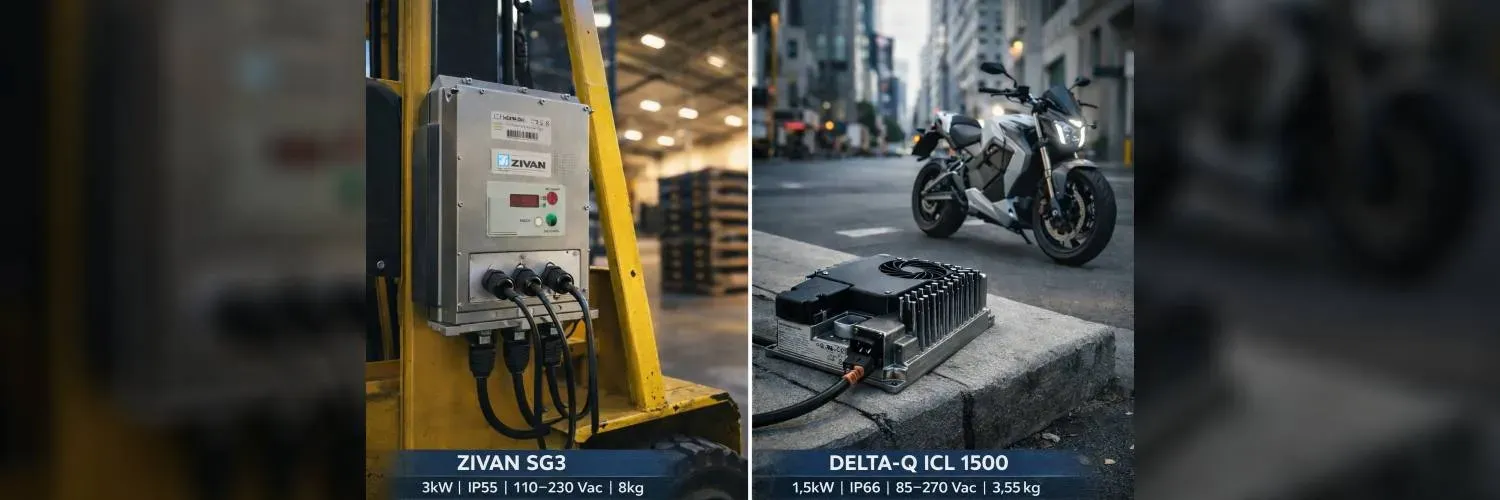
On a traction architecture built around a 96V nominal DC bus (48–120V depending on platforms), the onboard charger is not just an AC/DC converter. It directly drives the charging strategy (lead-acid / lithium), the environmental robustness (IP rating, temperature, vibration), and the supervision layer (BMS, vehicle controller, telematics). This page compares three commonly used references for retrofit and industrial machines: ZIVAN SG3 96V 25A, Delta-Q ICL1500, and ZIVAN CT3.3.
96V constraints
In embedded applications, charging must remain stable despite variable mains quality (workshop outlets, extension leads, generator sets) and thermal constraints. On a 96V bus, DC currents become significant: cable cross-sections, ohmic losses, and thermal derating directly impact machine availability. Integration must also account for real-world sealing (housing + connectors + harness), as well as EMC constraints when traction power and communications (CAN) share the same wiring harness.
Lead vs lithium
Lead: multi-stage
Lead-acid batteries (AGM, GEL, etc.) rely on multi-stage charging (bulk/absorption/float) with maintenance control and, depending on the use case, equalization phases. Field performance depends on voltage/current regulation accuracy and on phase durations that match the battery technology and real duty cycles.
Lithium: BMS control
For lithium, the charger must execute a clean CC/CV profile while remaining subordinate to the BMS: charge enable, current/voltage limits, safe shutdown on cell/temperature faults, and state reporting for diagnostics and maintenance. A usable CAN interface reduces commissioning ambiguity and supports robust fault handling.
Type 2 charging
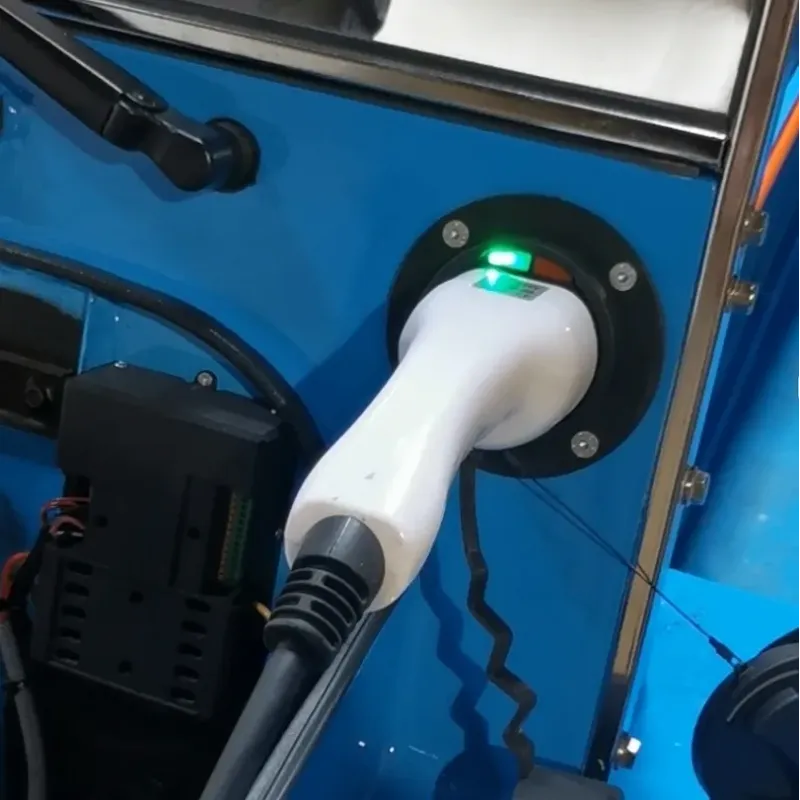
In electric mobility, the Type 2 interface is not only about the connector: it drives the charging user experience, integration compliance, and the complexity level on the vehicle side. Depending on the charger architecture, Type 2 handling can be native (integrated control and interlocking) or require an external module acting as the interface/EVSE.
- In a mobility-oriented integration, the CT3.3 can be deployed with a “natural” Type 2 approach, using an architecture aligned with modern onboard charging use cases.
- By contrast, more “classic” chargers such as SG3 and ICL1500 are typically integrated via an external Type 2 module (pilot control, charge enable, interlocks).
- In retrofit and multi-platform projects, the goal is to standardize the charging interface independently of the selected charger, in order to reduce harness/control variants.
- EVEA has developed an adaptation system that makes any onboard charger Type 2 ready: the conversion is implemented at the interface and control-logic level, without changing the charger power sizing.
- At integration level, it remains essential to address: AC protection, connector/harness sealing, water paths, vibration robustness, and EMC compatibility between power stages and pilot signals.
Comparison
The rating below (★ to ★★★★★) is intended for “design office integration”: environmental robustness, input range, system functions, and CAN usability. It does not replace proper sizing (charge time), but it accelerates selection against project constraints.
| Criteria | ZIVAN SG3 96V 25A | Delta-Q ICL1500 | ZIVAN CT3.3 |
|---|---|---|---|
| Charging power | ★★★★★ (3.0 kW) |
★★★☆☆ (1.5 kW) |
★★★★★ (3.3 kW) |
| AC input range | ★★★☆☆ (110–230 Vac) |
★★★★★ (85–270 Vac) |
★★★★★ (85–270 Vac) |
| IP rating | ★★★☆☆ (IP55) |
★★★★☆ (IP66) |
★★★★★ (IP67) |
| Operating temperature | ★★★☆☆ (-20…+50°C) |
★★★★★ (-40…+65°C) |
★★★★★ (-40…+70°C) |
| CAN monitoring | ★★★★☆ (CANopen + alarms + I/O) |
★★★★★ (CANopen / J1939 + logs) |
★★★★☆ (BMS wake-up + integration) |
| Battery chemistries | ★★★★★ (lead/gel + lithium via profiles) |
★★☆☆☆ (lithium-focused) |
★★★★☆ (lithium-focused) |
| System features | ★★★☆☆ (AUX, sensors, LEDs) |
★★★☆☆ (interlock, OEM protections) |
★★★★★ (500 W DC/DC, EVSE option, stacking) |
| Compactness | ★★☆☆☆ (≈8 kg) |
★★★★★ (≈3.55 kg) |
★★★★☆ (≈6 kg, air / liquid cooling) |
ZIVAN SG3
The SG3 positions itself as a versatile onboard charger in the 3.3 kW class, with PFC (power factor stated at 0.98) and a stated efficiency ≥90%. From an integration standpoint, it fits classic motive environments: charge-profile management, auxiliary I/O, and fault handling via a detailed alarm table.
- AC input 110–230 Vac ±10%, 50/60 Hz; stated max input current 15 Arms.
- Power 3.3 kW absorbed (Pmax), 3000 W delivered to the battery (Pmax).
- Environment IP55, -20 to +50°C; installation with clearance around fan/heatsink for full power.
- Charging configurable profiles (lead stages, dedicated modes), adjustable cable voltage-drop compensation.
- Interface CAN (Superseal connector) and auxiliaries (AUX1/AUX2, PT100/NPT100-type sensor, remote LED).
Delta-Q ICL
The Delta-Q ICL1500 is designed for OEM lithium integration: a usable CAN interface, CANopen and J1939 protocol support, and a structured diagnostic approach (states, faults, history) useful for industrialization and maintenance. IP66 (NEMA4) and the -40…+65°C temperature range make it a robust option for harsh environments.
- AC input 85–270 Vac, 50/60 Hz; power factor >0.99 (120 Vac) and >0.98 (230 Vac).
- Power 1500 W max; lithium final charge voltage variants 36–58V / 55–85V / 80–120V depending on model.
- Max current up to 33.3 A (~58 V variant), 25 A (85 V), 18.7 A (120 V) at Vin > 200 Vac.
- Protection reverse polarity (Poka-Yoke terminals + auto-reset protection), electronic current limiting on short circuit.
- Interface CAN, dry-contact interlock (0.3 A), DC connection via ring lugs (Neg M6 / Pos M8).
ZIVAN CT3.3
The CT3.3 targets “platform” architectures where the objective is to reduce the number of enclosures: 3.3 kW traction charger, integrated 500 W DC-DC for low-voltage supply, and an EVSE interface option depending on version. IP67, extended temperature capability, and liquid-cooling availability are decisive advantages when packaging is constrained or exposed.
- AC input 85–270 Vac; stacking possible 3.3 / 6.6 / 9.9 kW and beyond for scalable power.
- HV variants 58.8 V / 65 A; 65 V / 65 A; 120 V / 40 A (depending on version).
- AUX DC 13.7 V nominal configurable 12–14.5 V; 500 W in drive mode and 70 W in charging mode.
- Environment IP67; -40 to +70°C (full power up to 50°C); fan-cooled or liquid-cooled versions.
- Integration BMS wake-up, multi-pin signal connector, cybersecurity-oriented approach (AES128 stated).
Compatible accessories
The accessories below showcase a selection of components commonly integrated and/or recommended with FAQ: Choosing a 96V onboard charger for lead/lithium (CAN, IP65) – criteria + SG3/ICL/CT3.3 to optimize installation, compatibility, and overall performance.
| Category | Accessories |
|---|---|
| No compatible accessory. | |
Wiring & EMC
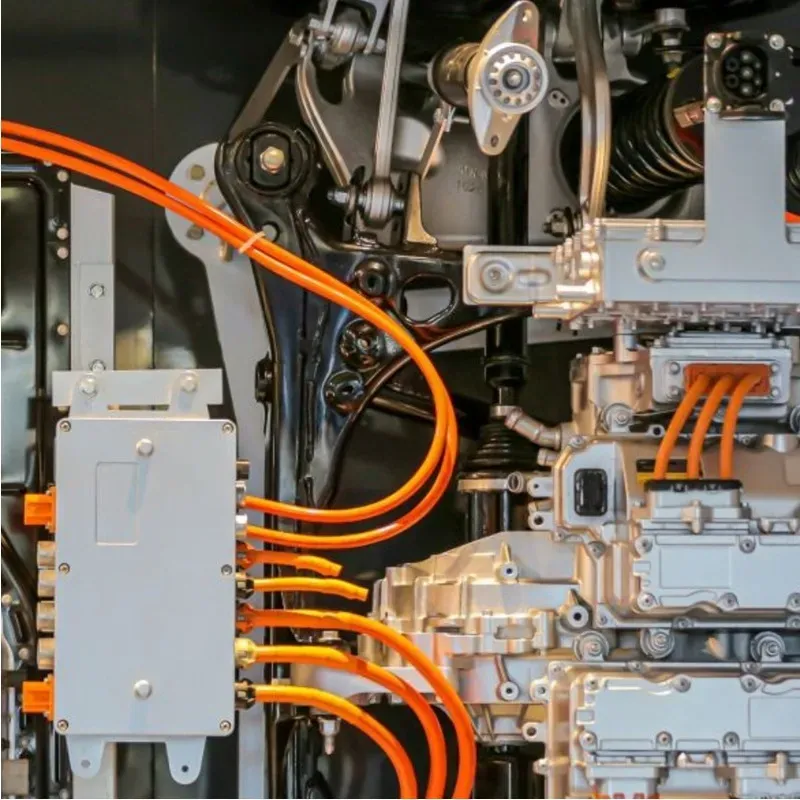
On 96V systems, charger integration is often decided by harness quality and EMC performance more than by nominal power. Design office and workshop best practices:
- Physically separate HV power (AC/DC) and signals (CAN, interlock, sensors); avoid long parallel runs.
- Size DC cable cross-sections based on charge current, allowable heating, and voltage drop; leverage cable-drop compensation where available.
- Engineer the CAN topology: lengths, termination, shield continuity, and a chassis/shield grounding strategy consistent with the vehicle.
- Reduce ground loops, stabilize 0V/control ground references, and document the grounding policy (star point, chassis, islands).
- Manage vibration: strain relief, bend radii, clamps, anti-abrasion zones, and locking connectors.
Quick choice
- Need 3.3 kW and multi-chemistry flexibility: ZIVAN SG3, suited to mixed fleets and legacy lead strategies with CAN and I/O integration.
- Lithium only + IP66 + structured OEM integration: Delta-Q ICL1500, relevant when the BMS drives charging and diagnostics/logs are central.
- Modern platform + IP67 + integrated DC/DC + scalable power: ZIVAN CT3.3, coherent for an integrated and industrializable architecture.
Articles
Discover below our dedicated articles, featuring detailed answers to the most common technical questions, along with in-depth information to help you better understand installation, compatibility, use, maintenance, and warranties.
| Category | FAQ / Article(s) |
|---|---|
| FAQ : ELECTRIC MOTORS | |
| FAQ: VARIABLE SPEED DRIVES (LV traction controllers / inverters) | |
| FAQ: Battery Chargers | |
| FAQ : ELECTRIC CONVERSION KITS |