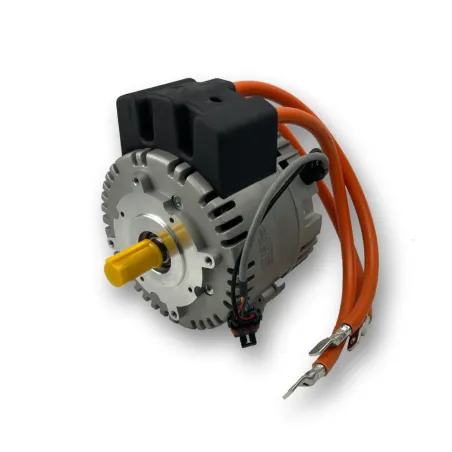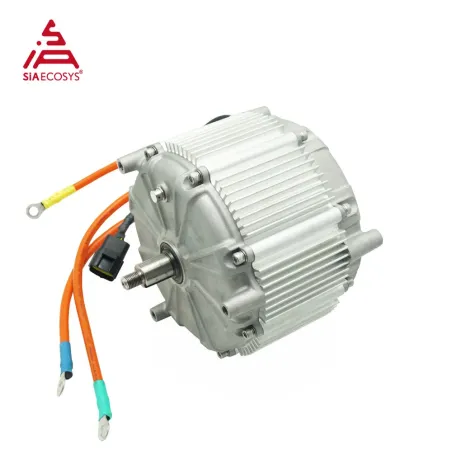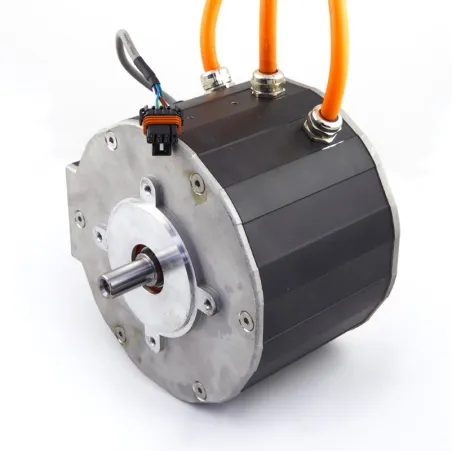
PMSM - 96V - 230A - 48KW
€11,998.80
tax. incl.
€9,999.00 tax. excl.
€9,999.00 tax. excl.

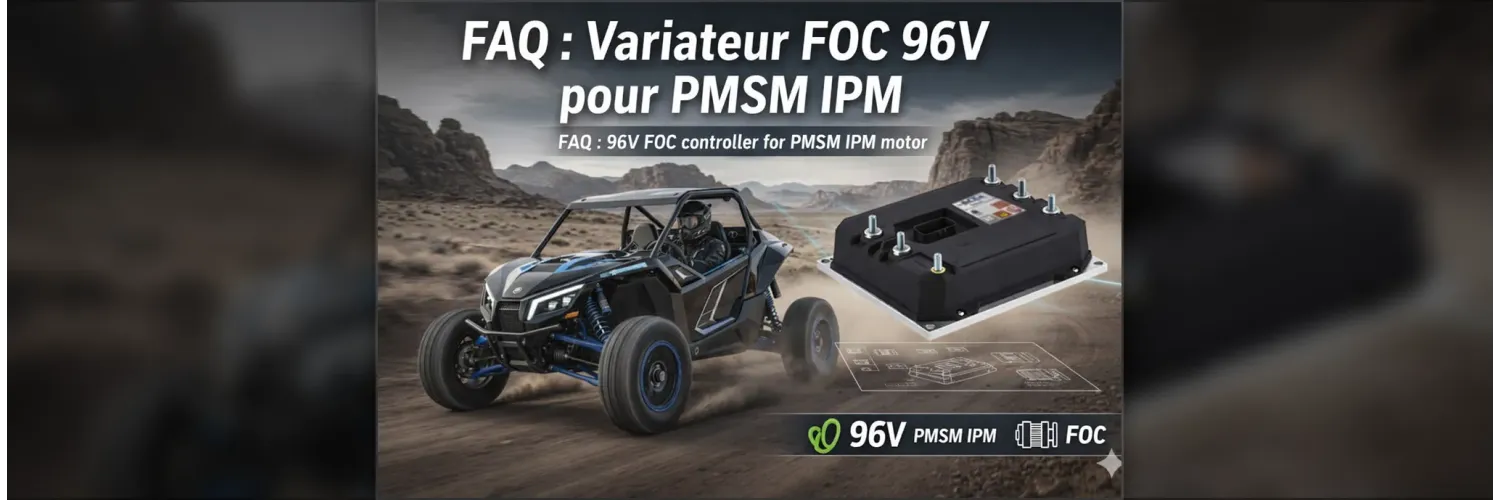
Selecting a 96V FOC inverter for an IPM PMSM is not about ticking “FOC” on a datasheet. The real differences show up in the controller’s ability to exploit IPM control (Id/Iq, MTPA, field weakening), the stability of the base speed → field weakening transition, robustness against the position sensor (here an ABZ incremental encoder), and, above all, a repeatable commissioning process in a real system (BMS, harness, vehicle).
This page provides an engineering selection method for traction integration, then illustrates it on the SiAECOSYS SIA155-64 motor (96V, 12 kW nominal / 29 kW peak).
Need to validate SIA155-64 ↔ inverter compatibility (BLE2 / 1236SE / F2-F4) and the CAN BMS strategy? EVEA can qualify the motor/controller pair and frame the critical parameters (commissioning, field weakening, current limits, regen).
With an IPM PMSM (interior magnets), the inverter controls two current components: Iq (torque-producing current) and Id (flux current). Iq produces traction torque, while Id is used to maximize torque per amp (MTPA) and to enable field weakening above base speed (negative Id).
Practically, an “IPM-ready” controller must allow a clean base speed → field weakening transition, without torque plateaus or discontinuities, and with explicit limits so that field weakening is not used “at any cost” (efficiency drop, heating, magnet stress).
SIA155-64 case: a versatile motor (urban / enduro / track), typical usable torque ~70 Nm, max speed 7–8 krpm. At 96V, field weakening around ~4,000 rpm makes the transition a key tuning area.
On industrial platforms (ZAPI, Curtis), the difference between “it runs” and “it runs well” is mostly in parameterization. A poor setup typically shows up at the base speed ↔ field weakening transition, more than at very low speed.
The engineering goal is to learn and reproduce a stable calibration, then refine it in the real context (inertia, drivetrain, aerodynamic load, mass distribution).
The SIA155-64 uses a single-ended ABZ incremental encoder. Channels A/B (quadrature) provide incremental position and direction; the Z index (one pulse per revolution) provides a reference and is commonly used in traction setups.
ABZ is valued in traction environments for its EMC robustness: edge-based digital decoding tolerates noisy power environments better than analog Sin/Cos signals. The trade-off is that ABZ single-ended support may depend on specific inverter references.
In practice, manufacturing tolerances (motor + encoder mounting) justify a simple rule: new motor = recalibration. The goal is not to “redo all FOC”, but to secure sensor learning and intrinsic motor parameters.
Industrial inverters originate from material-handling applications: rideability is achieved through mapping and ramps. Choices differ between speed command (industrial, marine) and torque command (vehicle).
A robust 96V traction architecture is often CAN BMS ↔ inverter. The BMS provides max discharge current and max charge current, and the inverter limits traction torque and regen accordingly.
Two “feel” effects are expected and should be designed-in:
These are not defects: they are direct consequences of battery protection using dynamic limits.
Current sizing must match the use case: continuous (thermal) vs peak (dynamic), and the field-weakening strategy. For the SIA155-64, typical operating orders of magnitude are:
| Key parameter | Indicative value | Integration note |
|---|---|---|
| Continuous current (RMS) | 125 A | Baseline for sustained operation; thermal stability reference. |
| Manufacturer peak | 300 A / 10 s | Motor limit; reserve for controlled transients. |
| Typical EVEA dynamic setting | 250 A / 10 s | With ~2 minutes back-to-safe regime. |
| Field-weakening onset (96V, typ.) | ~4,000 rpm | Critical tuning zone; transition must remain progressive. |
| Typical exploitable max speed | 7–8 krpm | Depends on project, cooling, and FW limits. |
In field weakening, the goal is not to “hold speed at all costs”. If the application forces negative Id to the point where efficiency and temperature collapse, it is usually a sign that motor/application sizing should be revisited (or higher cooling capability).
For a 96V traction integration with SIA155-64 and a single-ended ABZ encoder, the following references are solid baselines:
Important: single-ended ABZ is supported natively through specific references (not an add-on option). This impacts selection and sometimes availability.
The accessories below showcase a selection of components commonly integrated and/or recommended with FAQ: 96V FOC inverter for IPM PMSM (ABZ encoder): engineering criteria & CAN BMS integration to optimize installation, compatibility, and overall performance.
| Category | Accessories |
|---|---|
| BLAC MOTORS |
| Integration criterion | ZAPI BLE2 96V | Curtis 1236SE 96V | Curtis F2 / F4 |
|---|---|---|---|
| Single-ended ABZ + Z index support | Yes (compatible reference) | Yes (compatible reference) | Yes (reference-dependent) |
| Base speed → field weakening tuning stability | Commissioning-dependent, robust baseline | Commissioning-dependent, stable when phased | Commissioning-dependent, newer generation |
| Commissioning tools / diagnostics | Workshop-ready, useful auto-tune options | Vendor tools, useful diagnostics | Recent tools depending on version |
| CAN BMS integration (charge/discharge limits) | Common architecture | Common architecture | Common architecture |
| Regen strategy (brake input, ramps, levels) | Configurable, matches EVEA approach | Configurable | Configurable |
| Supply-chain (ABZ less common) | Specific reference → plan availability | Specific reference → plan availability | Specific reference → plan availability |
| Best-fit use cases | IPM traction + kit approach | IPM traction + kit approach | Evolving projects / newer generation |
The matrix does not replace commissioning: it frames platform selection. Final performance depends on calibration and vehicle integration.
Why does ABZ narrow inverter choices?
Because single-ended ABZ is less standard than other sensors on some product lines; compatibility often depends on specific references.
What is the Z index used for in traction?
It provides a once-per-revolution reference that helps with indexing and certain learning/phasing sequences.
Why does regen disappear on a full battery?
The BMS limits allowable charge current. When the pack is full, acceptance drops and regen is reduced or disabled.
Why recalibrate per motor?
Motor and encoder mounting tolerances shift phasing and identified parameters. Recalibration ensures stability and performance.
Why is the base speed → field weakening transition critical?
This is where control switches to negative Id strategy. If tuning is off, it is felt immediately (plateau, steps, non-linearity).
Discover below our dedicated articles, featuring detailed answers to the most common technical questions, along with in-depth information to help you better understand installation, compatibility, use, maintenance, and warranties.
| Category | FAQ / Article(s) |
|---|---|
| ELECTRIC CONVERSIONS | |
| FAQ : ELECTRIC MOTORS | |
| FAQ : ELECTRIC CONVERSION KITS |