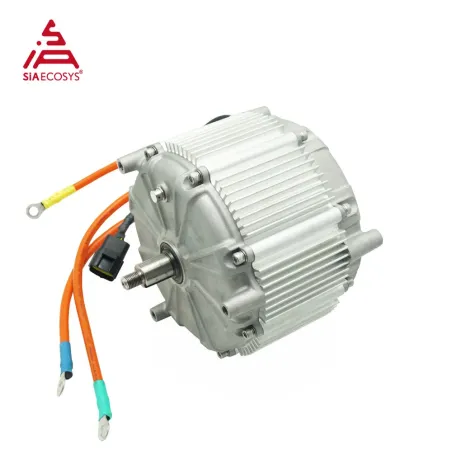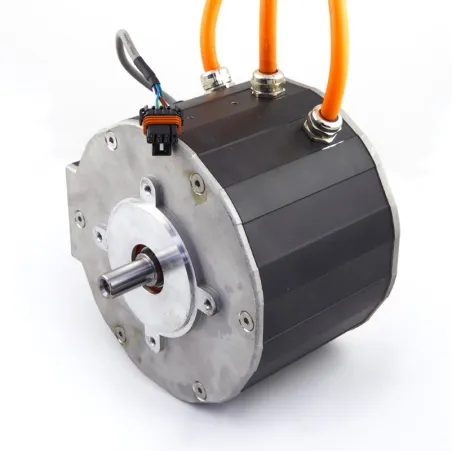
PMSM - 96V - 230A - 48KW
€11,998.80
tax. incl.
€9,999.00 tax. excl.
€9,999.00 tax. excl.

In 96V traction (electric motorcycle, kart, industrial prototype), the terms PMSM, BLDC and IPM are often used as if they were incompatible technologies. In practice, what you feel (smooth torque, dynamics, efficiency, noise) depends mainly on the control strategy and the rotor position feedback. In modern traction architectures, PMSM, IPM and a large share of motors sold as “BLDC” are driven with FOC. The real trade-off appears when you choose—or are forced into—trapezoidal current (6-step commutation), which comes with specific constraints.
This page provides an integration-driven decision framework (inverter, sensors, thermal, EMC), with practical reference points using three representative motors: Motenergy ME1115 (PMSM/BLAC), Golden Motor HPM 10kW (BLDC) and SIA155-64 (IPM).
96V is frequently selected to reduce current compared with 48–72V at similar power, while staying compatible with common components (protections, contactors, chargers, BMS, inverters). The motor choice must align with traction targets and system-integration constraints.
In traction, PMSM very often refers to a BLAC approach: phase current is sinusoidal (or pseudo-sinusoidal depending on PWM) and control is typically FOC. This architecture commonly relies on high-resolution position feedback, including SIN/COS interfaces, to stabilise the torque loop—especially at low speed and during fast transients.
PMSM/BLAC example: Motenergy ME1115, often selected for traction projects targeting clean FOC behaviour and a consistent torque/speed operating envelope.
The term BLDC can be ambiguous: it may describe a permanent-magnet machine driven with FOC (therefore close to a PMSM from a control perspective), or a setup intended for 6-step commutation with trapezoidal current. In the latter case, traction compromises become more visible.
BLDC example: Golden Motor HPM 10kW. Depending on the controller, it can be used with more or less advanced strategies, but trapezoidal operation requires you to explicitly design around the constraints above.
IPM (Interior Permanent Magnet) describes a rotor topology with embedded magnets. It is not “against” PMSM: IPM is a family of permanent-magnet synchronous machines, frequently referenced in traction because it can deliver high torque density and an attractive usable operating range. Integration typically combines FOC with careful thermal management and supervision.
IPM mid-drive 96V example: SIA155-64, representative of a torque/dynamics-oriented architecture to be integrated with a FOC inverter and disciplined EMC/thermal design.
The accessories below showcase a selection of components commonly integrated and/or recommended with FAQ: PMSM vs BLDC for 96V electric motorcycle/kart (FOC, BLAC sinusoidal, IPM, integration checklist) to optimize installation, compatibility, and overall performance.
| Category | Accessories |
|---|---|
| BLAC MOTORS |
A 96V drivetrain must be engineered as a complete energy chain: battery, protections, DC bus, inverter, motor, sensors and emergency stop. The goal is reliability and prevention of destructive events caused by transients, sequencing errors and uncontrolled limits.
- Protect the DC bus: appropriate fuse, isolation/sectioning and consistent voltage/current ratings.
- Avoid inrush at power-up: main contactor + precharge resistor to limit current into the inverter DC link.
- Define an activation sequence: precharge, close contactor, enable inverter, then torque command.
- Design a safe shutdown: open contactor, controlled discharge, emergency stop and restart conditions.
- Instrument for diagnostics: motor/inverter temperatures, fault events and logging.
In traction, FOC stability and sensor reliability depend heavily on wiring and EMC. SIN/COS encoder links (or equivalent), optional CAN networks and control signals must remain robust in the presence of switched motor phases and DC bus transients.
- Physically separate power and signals: U/V/W phases and DC bus away from sensors and communication links.
- Use disciplined routing: twisted pairs, shielding when needed, controlled grounds and minimised loops.
- Size and secure harnesses: strain relief, vibration retention, bend radius and protected paths.
- Ensure connector quality: industrial crimping, sealing if exposed, consistent shield continuity.
- Validate under real scenarios: low-speed under load, torque/regen transitions, disturbances and temperature limits.
Before freezing a 96V motor and inverter, lock down current/thermal consistency, the FOC strategy, sensor compatibility and mechanical integration. This checklist reduces the risk of unstable behaviour and unexpected derating.
| Power & current | Separate nominal vs peak, continuous vs burst; confirm thermal capability and alignment with the FOC inverter. |
|---|---|
| FOC control | PMSM/IPM compatibility and sensor strategy; voltage/current limits, protections and degraded modes. |
| Sensors | SIN/COS (or equivalent), Hall depending on architecture; sensor supply, EMC robustness, behaviour on sensor loss. |
| Current shape | Sinusoidal/pseudo-sinusoidal in BLAC; with trapezoidal (6-step), accept torque ripple, noise and EMC constraints. |
| Mechanical & IP | Shaft/transmission interface, mid-drive constraints, mounts and vibration, IP rating and thermal design. |
| 96V architecture | Protected DC bus, precharge, contactor, emergency stop, wiring discipline and validation on real duty cycles. |
Reference points for 96V comparisons: Motenergy ME1115 (PMSM/BLAC), Golden Motor HPM 10kW (BLDC) and SIA155-64 (IPM mid-drive). Use the product and editorial links below to move from comparison to selection and compatibility checks.
Discover below our dedicated articles, featuring detailed answers to the most common technical questions, along with in-depth information to help you better understand installation, compatibility, use, maintenance, and warranties.
| Category | FAQ / Article(s) |
|---|---|
| FAQ : ELECTRIC MOTORS | |
| FAQ: VARIABLE SPEED DRIVES (LV traction controllers / inverters) | |
| FAQ: Battery Chargers | |
| FAQ : ELECTRIC CONVERSION KITS | |
| FAQ : LEAD AND LITHIUM BATTERIES |