


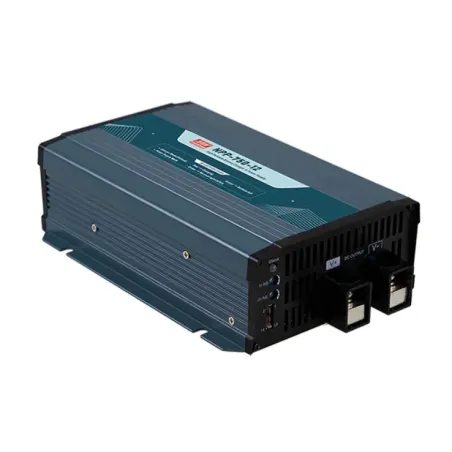
48V - CAN bus - 11.3A - 0.759KW
€298.80
tax. incl.
€249.00 tax. excl.
€249.00 tax. excl.

The ZIVAN SG3 48V 60A is a 48V lithium battery charger designed for onboard and industrial architectures that require both charging power, mechanical compactness and environmental resistance. In this stand-alone CU3 version, it targets lithium packs operated autonomously, with a 95 to 265 VAC single-phase input, a maximum current of 60 A, 3 kW of power and an IP65 enclosure suitable for integration on a vehicle, mobile machine or traction equipment.
This SG3 variant differs from a CAN charger controlled by a BMS through an autonomous lithium-oriented operating logic, without relying on a CAN slave architecture to manage charging. For an integrator, this makes it a relevant 48V 60A onboard charger when a simple, robust mains charging solution must remain directly integrated on board, while relying on the SG3 platform known for its power density, cycle memory and resistance to harsh environments.
The positioning of this ZIVAN charger is based on a combination sought after in retrofit, light to medium traction and special equipment projects: 48 V nominal voltage, high charging current, onboard format and IP65 protection rating. Where an entry-level 48V lithium charger mainly targets standardised or low-power uses, the SG3 48V 60A fits into a system integration approach. Its role is not only to recharge a lithium battery, but to ensure stable charging in an environment where mains supply, available ventilation, cable length and operating constraints must be controlled from the design stage.
CU3 logic is the decisive functional point here. In this version, the SG3 is configured for autonomous lithium use and should not be read as a generic lead/lithium charger. This distinction is important to avoid errors during pre-project selection: a stand-alone CU3 charger suits an architecture where charging is managed locally by the charger configuration, whereas a CAN slave version is part of an architecture more dependent on communication with a BMS. For an engineering office, this difference directly affects the wiring strategy, the level of electronics required around the charger and the validation logic of the charging sequence.
In the field, one point that should not be overlooked concerns the actual end-of-charge voltage available. For this 48 V autonomous lithium variant, the working value to retain is around 63 V according to the current product scope, which should be checked against the maximum admissible pack voltage, BMS balancing and the available margin on 15S or 16S lithium assemblies depending on the chemistry used. This is an important integration topic, because a charger can be correct at 48 V nominal voltage while becoming limiting or, on the contrary, oversized with regard to the actual maximum voltage of the installed pack.
| Brand | ZIVAN |
| Model | SG3 |
| Internal reference | ZIV-SG3-48V-CU3 |
| Product type | 48V lithium battery charger |
| Operating mode | Stand-alone CU3 |
| Associated battery type | BA3 for lithium-ion in CU3 configuration |
| Target chemistry | Lithium-ion |
| Nominal battery voltage | 48 V |
| Maximum output voltage | See charge curve sheet; working product value around 63 V to be confirmed on the reference curve |
| Maximum charge current | 60 A |
| Maximum delivered power | 3 kW |
| Maximum absorbed power | 3.3 kW |
| Input voltage | 95-265 VAC |
| Supply | 115 / 230 VAC single-phase |
| Frequency | 50 / 60 Hz |
| Power factor | 0.98 |
| Cooling | Air |
| Efficiency | up to 93% |
| Enclosure protection rating | IP65 |
| External fan protection rating | IP55 |
| Ambient operating temperature | -20 to +50 °C |
| Thermal sensor range | -20 to +55 °C |
| Maximum relative humidity | 90% |
| Dimensions | 324 x 204 x 142 mm |
| Product weight | 8 kg |
| Data logging | Up to 1000 charging cycles |
| Mounting | Onboard |
| Native communication bus | Isolated CAN Bus 2.0 |
| Auxiliary contacts | Programmable AUX1 and AUX2, 4 A |
| Remote LED | COM + green LED + red LED |
| Thermal sensor | PT100 / NPT100 depending on wiring |
| Protections | Output short-circuit, reverse polarity protection by fuse |
| Cable voltage drop compensation | Adjustable from 0.0 to 1.5 V in 0.1 V steps on display version |
The SG3 retains the hardware attributes that make the series relevant for onboard uses. Its 95-265 VAC, 50/60 Hz input facilitates integration in environments with varying mains supply, while air cooling, a 0.98 power factor and high efficiency contribute to cleaner operation on a single-phase network. With dimensions of 324 x 204 x 142 mm and a weight of around 8 kg, the charger remains easy to integrate in compact technical compartments, provided that at least 50 mm of clearance is preserved near the fan and heat sink. This remains decisive at 60 A, because the thermal behaviour of the compartment directly affects charging stability and operating durability.
In real use, this reference mainly targets integrators looking for a 48V 60A lithium battery charger that remains onboard the machine rather than a remote workshop charger. The benefit is twofold: reducing handling and external interfaces, and maintaining a charging architecture consistent with the vehicle or equipment. This typically concerns compact industrial vehicles, special machines, light handling equipment, electric conversion applications or autonomous 48 V systems requiring reliable mains charging without a complex supervision infrastructure.
The accessories below showcase a selection of components commonly integrated and/or recommended with ZIVAN - SG3 - 48V 60A lithium charger to optimize installation, compatibility, and overall performance.
| Category | Accessories |
|---|---|
| BATTERY CHARGERS | |
| LITHIUM BATTERIES |
In this logic, project compatibility can be considered with 48 V lithium batteries from the EVEA catalogue, especially PowerTech 48 V formats, provided that consistency is validated between end-of-charge voltage, BMS strategy, cable cross-section, protections and pack operating mode. This mention is useful for catalogue internal linking, but it must remain a project-level integration compatibility to be confirmed, not automatic interchangeability between all 48 V packs on the market.
The IP65 rating reinforces this positioning. In a project where the charger must withstand dust, splashes and a harsher working environment than a standard technical room, enclosure resistance becomes as important a selection criterion as voltage or current. It must nevertheless be remembered that an IP65 charger does not replace good installation practices: cable entry quality, connector protection, prevention of water stagnation points, bracket mechanical strength and thermal clearance control all remain essential. On a 48V charger intended for a professional environment, installation weaknesses usually appear before electronic weaknesses do.
For electrical integration, the current level means the charger must be treated as a power subsystem in its own right. Output cable sizing, voltage drop up to the battery terminals, tightening quality, short-circuit protection and maintenance accessibility must all be considered from the routing stage. At this power level, a poorly designed architecture quickly degrades the charging quality experienced by the pack. The SG3 therefore makes more sense in a project where wiring, protections, thermal behaviour and charging operating procedures are properly documented, rather than in a simple catalogue substitution approach.
Another practical strength of the SG3 lies in its auxiliary interfaces. The charger features two programmable auxiliary contacts, AUX1 and AUX2, each available through COM / NO / NC contacts, with a stated 4 A rating. In an autonomous lithium architecture, these outputs can serve useful field functions, for example signalling mains presence, indicating that charging is in progress, driving an auxiliary device or keeping a battery system awake while the charger is powered, subject to validation of the final schematic by the integrator.
This becomes even more useful when the charger is hard to see once installed. SG3 documentation also provides an interface for remote LEDs, with COM, green LED and red LED lines, as well as an optional display of voltage, current, charged Ah and remaining time depending on the version. In practice, this makes it possible to keep visual status feedback even if the charger is mounted in an enclosed or difficult-to-access compartment, improving operation and diagnostics without dismantling the surrounding installation.
The first advantage of this version lies in its functional autonomy. For a 48 V lithium project that does not rely on CAN-supervised charging, the stand-alone CU3 configuration allows a simpler deployment logic, easier maintenance and more readable commissioning tests. This can reduce the need for additional interfaces when the main objective is to obtain robust and repeatable onboard charging.
The second advantage is its integration format. A ZIVAN SG3 48V 60A charger integrates more naturally into a vehicle or machine when charging must remain onboard and a single-phase mains supply is available on site. This approach is relevant for retrofit, compact industrial vehicles, handling equipment, special equipment, light agricultural applications or mobile 48 V machines. In these cases, consistency between charger, battery, protections and environment matters more than the current value alone.
The third advantage is its ability to address a qualified technical demand. For a specifier looking for a 48V lithium battery charger with a real level of robustness, the combination of 60 A, 3 kW, IP65 and onboard architecture helps move beyond the highly competitive segment of low-power chargers. The page must therefore speak to a reader comparing integration solutions, not simply charging accessories.
The fourth advantage is the richness of its peripheral functions. Between memory of up to 1000 cycles, optional thermal compensation, programmable auxiliaries, remote LEDs and curve parameter setting, the SG3 provides useful levers to make real-world use more reliable and commissioning more precise, which is often more decisive in B2B projects than a simple comparison of nominal power.
Is this ZIVAN SG3 charger suitable for a 48V lithium battery?
Yes. This version is intended for autonomous 48 V lithium use, with a stand-alone CU3 charging logic. Final validation must still focus on the end-of-charge voltage, the BMS and the curve actually loaded into the reference.
What is the difference between a stand-alone CU3 version and a CAN / RE version?
The stand-alone version relies on an autonomous charging logic integrated into the charger, whereas a CAN / RE version fits into an architecture controlled by a communicating BMS.
Is the SG3 48V 60A an onboard charger?
Yes. Its compact format, onboard mounting and IP65 protection rating make it suitable for integration on vehicles or machines.
Can it be associated with PowerTech 48 V lithium batteries?
Yes, within a project compatibility and internal linking logic, provided that maximum charging voltage, BMS behaviour and the overall electrical architecture are verified.
What are auxiliary contacts and remote LEDs used for?
AUX outputs can be programmed for functions such as mains presence or charge in progress. Remote LEDs allow charger status to be reported when the charger is mounted in a compartment with limited access.
What mains supply is required?
The charger operates on a 95 to 265 VAC single-phase input at 50/60 Hz, which facilitates use across different network environments.
The value of this model finally lies in its fit with an intermediate demand often poorly covered by the generic SERP: an onboard 48V charger intended for professional use, more robust and denser than a small charger for light mobility, yet without moving to a heavy charging cabinet or a three-phase infrastructure. This is precisely why the terms 48V traction charger, IP65 charger, 48V onboard charger, 48 V lithium battery compatibility and ZIVAN SG3 should naturally be associated in the page to reflect the real positioning of the product.
The ZIVAN SG3 48V 60A in stand-alone CU3 lithium version meets a precise requirement: providing a robust onboard 48V lithium battery charger sized for industrial or mobile integration without depending on a CAN charging architecture. Its relevance must still be assessed at full system level. Final validation should therefore always cover the battery-charger-wiring-protection-environment assembly before commissioning, with particular attention to the maximum voltage actually required by the lithium pack and the auxiliary functions used in the final architecture.
Discover below our dedicated articles, featuring detailed answers to the most common technical questions, along with in-depth information to help you better understand installation, compatibility, use, maintenance, and warranties.
| Category | FAQ / Article(s) |
|---|---|
| No related FAQ or article. | |
Frequently associated searches for this product: lithium battery chargers, 48v battery charger, industrial onboard charger. Voir la catégorie correspondante
Fiche rédigée par Camille F. et relue par l’équipe technique EVEA Distribution — Dernière mise à jour le 03/04/2026.

EVEA Distribution – Datasheet
Generating PDF, please wait…
Datasheet
Datasheet
Modèle 3D