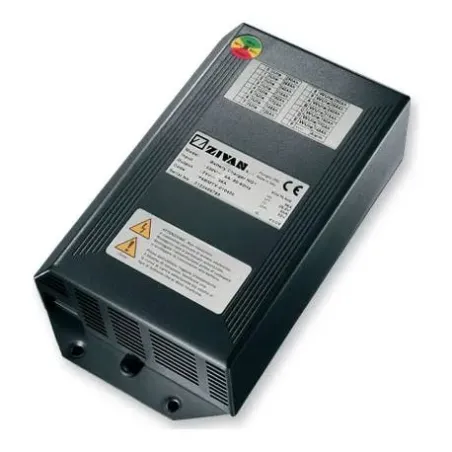


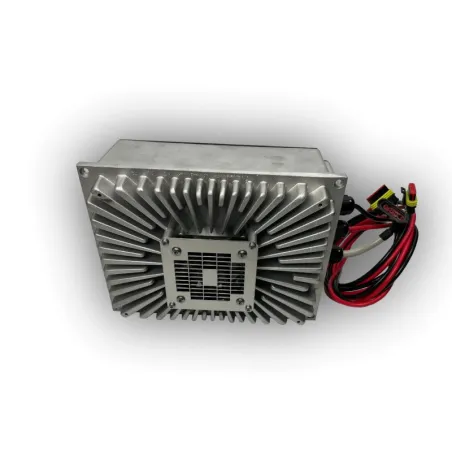
CAN-Bus - 550A - 12kW - 4000rpm
€2,738.12
tax. incl.
€2,281.77 tax. excl.
€2,281.77 tax. excl.

The POWERTECH PowerBrick + 48V 32Ah is a 48V 32Ah LiFePO4 lithium battery designed for 48V architectures that require a compact, sealed pack ready for light traction, onboard auxiliary power or replacement of 48V AGM lead-acid batteries. With a nominal voltage of 51.2V, 1.64 kWh of energy, an integrated BMS and an IP65 ABS enclosure, it targets applications where packaging, onboard weight and electrical stability must remain under control.
This 48V lithium battery with integrated BMS combines 32Ah of nominal capacity, 65A continuous discharge and a weight of 13.2 kg in a 260 x 168 x 212 mm format. It is suited to compact 48V systems that need to replace a 48V lead-acid battery, power a mobile machine, support onboard auxiliary functions or handle light traction with moderate to sustained current peaks.
The core of the product is based on LiFePO4 chemistry managed by an onboard BMS responsible for cell monitoring, balancing and electrical protection. For a query such as 48V 32Ah LiFePO4 battery with integrated BMS, the key point is not only the nominal capacity, but the overall consistency of voltage, current and protection. The PowerBrick + operates at 51.2V nominal, accepts CC/CV charging at 57.6V ± 0.8V, cuts charging at 59.2V ± 0.4V and interrupts discharge at 40V. In real integration work, these thresholds mean that charger compatibility, supervision strategy and end-of-discharge system behaviour must be validated rather than reasoning only in terms of a generic “48V battery”.
With 1.64 kWh of stored energy, this compact 48V battery offers an interesting energy density for projects where every litre and kilogram matters. Its compact packaging makes it easier to replace a 48V AGM lead-acid battery with lithium while keeping a similar installation volume and significantly reducing subsystem weight. This approach is especially useful on light carts, mobile robots, handling equipment, onboard auxiliary power, small marine applications or mobile energy modules. The gain is not limited to range: it also improves voltage stability, current availability and the mechanical simplification of a lighter pack.
| Model | PowerBrick + 48V-32Ah |
| Type | Lithium iron phosphate battery (LiFePO4) |
| Nominal voltage | 51.2 V |
| Nominal capacity | 32 Ah |
| Energy | 1.64 kWh |
| Continuous charge current | 16 A |
| Maximum charge current | 32 A |
| Charge voltage | 57.6 V ± 0.8 V |
| BMS charge cut-off voltage | 59.2 V ± 0.4 V |
| Continuous discharge current | 65 A |
| Maximum discharge current | 100 A for less than 30 s |
| Instantaneous discharge current | 270 A ± 30 A for max. 100 ms |
| BMS discharge cut-off | 40 V |
| Internal resistance | ≤ 50 mΩ |
| Efficiency | > 98 % |
| Self-discharge | < 3 % per month |
| Protection rating | IP65 |
| Dimensions | 260 x 168 x 212 mm |
| Weight | 13.2 kg |
| Terminals | M8 |
| Charge temperature | 0 °C to +60 °C |
| Discharge temperature | -20 °C to +60 °C |
| Parallel assembly | up to 16 units |
| Certifications | CE, RoHS, UN38.3 |
Discharge behaviour is a decisive criterion for a 48V 65A continuous battery intended for a mobile machine or a light-traction architecture. The PowerBrick + delivers 65A continuously, 100A for less than 30 seconds and up to 270A ± 30A in a very short 100 ms pulse. This makes it suitable for applications with transient current peaks, for example at start-up, during rapid speed changes or when several DC loads are switched simultaneously. However, this level of performance requires disciplined integration: cable cross-section, upstream protection, connection quality and load-shedding strategy must be defined from the design stage to avoid unnecessary trips or voltage drops.
The battery also stands out through an internal resistance ≤ 50 mΩ, efficiency above 98% and self-discharge below 3% per month. For an integrator, these figures translate into lower losses, improved stability in intermittent service and more consistent availability on equipment that does not operate continuously. This 48V IP65 lithium battery is therefore not just an energy reservoir; it is a system component that directly influences harness behaviour, charger interaction and DC distribution. Its sealed ABS enclosure protects the pack against dust and water splashes, but the local environment remains critical: installation near a heat source, an uncontrolled compartment or vibrations transmitted to the terminals can degrade the overall subsystem.
The accessories below showcase a selection of components commonly integrated and/or recommended with PowerTech - PowerBrick Pro 48V 32Ah - LiFePO4 Battery to optimize installation, compatibility, and overall performance.
| Category | Accessories |
|---|---|
| ELECTRIC CONVERSIONS | |
| BATTERY CHARGERS |
As a 48V LiFePO4 traction battery, the main value of this reference is its ability to cover real use cases without moving to a heavy or oversized pack. It is suitable for 48V light-traction applications, onboard auxiliary systems, mobile robots, compact industrial equipment, special carts, some marine auxiliary functions and hybrid architectures where available space is limited. Its -20 °C to +60 °C discharge temperature range allows use on equipment exposed to varied conditions, provided ventilation, mechanical retention and cable protection are handled correctly.
For a 48V lead-acid replacement, the practical interest lies in reduced weight, improved energy delivery and lower operating losses. However, replacement should never be treated as a simple electrochemical swap. The real charger voltage, its CC/CV profile, the absence of unsuitable float behaviour, charging current consistency and system behaviour relative to the BMS cut-off threshold must all be checked. On this reference, the M8 terminals are also an important detail: they affect lug selection, cable retention and long-term tightening reliability. It may seem minor, but it is critical in a 48V architecture exposed to vibration or current peaks.
The possibility of connecting up to 16 batteries in parallel broadens the use cases toward higher autonomy requirements without changing system voltage. This modularity is relevant for projects that want to keep a 48V base while increasing available capacity. It nevertheless requires a rigorous approach: matched cable lengths, balanced impedances, coherent protection and a controlled connection sequence. For a 48V battery used in onboard auxiliary service or in a mobile industrial subsystem, this scalability is an advantage only if dimensioning is considered at system level rather than cell by cell.
The charger must be compatible with CC/CV charging at 57.6V ± 0.8V and must not impose an unsuitable float strategy. Validation has to be based on the real end-of-charge setpoint, not simply on the label “48V charger”.
Yes, provided the 65A continuous current and 100A transient peaks for less than 30 seconds remain consistent with the machine, motor and controller duty profile. It can also replace a 48V AGM battery in many compact architectures, provided charger compatibility and system protection are properly checked.
The POWERTECH PowerBrick + 48V 32Ah positions itself as a compact 48V 32Ah lithium battery with technical consistency for 48V integrations that require a strong balance between packaging, available energy, current capability and robustness. It is particularly relevant for 48V light traction, onboard auxiliary power or 48V AGM lead-acid replacement, provided the charger architecture, protection, cabling and supervision are validated as a complete system before commissioning.
Discover below our dedicated articles, featuring detailed answers to the most common technical questions, along with in-depth information to help you better understand installation, compatibility, use, maintenance, and warranties.
| Category | FAQ / Article(s) |
|---|---|
| FAQ: Battery Chargers |
Frequently associated searches for this product: 48v traction lifepo4 battery, 48v battery for electric motor, compact 48v lithium battery. See the corresponding category
Product sheet written by Camille F. and reviewed by the EVEA Distribution technical team — Last updated on 18/06/2026.

EVEA Distribution – Datasheet
Generating PDF, please wait…